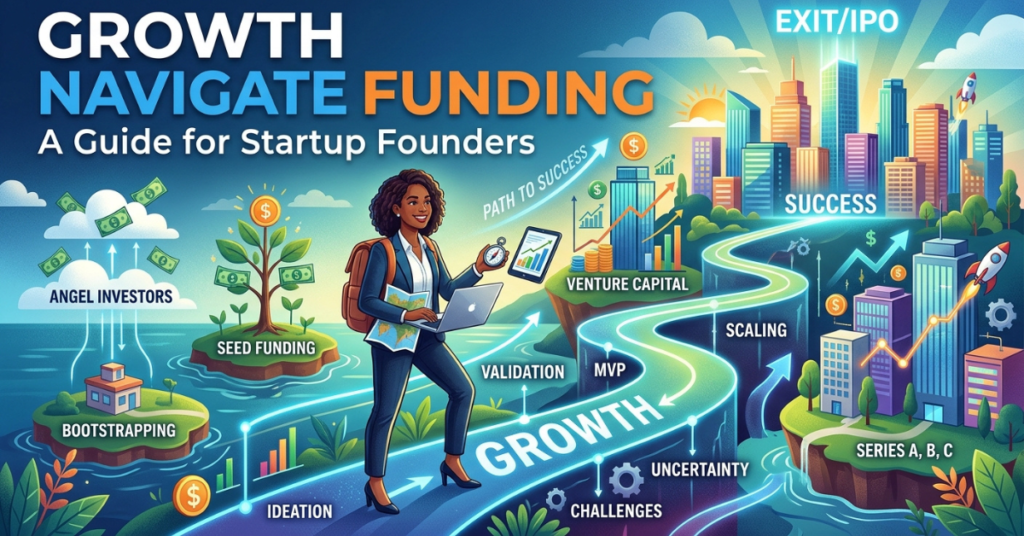

Starting a business is exciting, but turning an idea into a successful company requires more than determination and a good product. Founders also need financial resources, a clear business strategy, and access to the right investors. This is where Growth Navigate Funding becomes an interesting topic for entrepreneurs looking to build and expand their businesses.
Whether you are launching a startup, preparing for your first investment round, or planning to expand an established company, understanding how business funding works can make a significant difference. Choosing the right funding strategy helps businesses manage expenses, develop products, attract customers, and build a stronger position in the market.
Growth Navigate Funding is also the name of an online startup fundraising advisory service that presents itself as a partner for businesses seeking investment support. Its advertised services include fundraising strategy, pitch deck development, financial modeling, investor introductions, and due diligence preparation.
In this guide, we explore what Growth Navigate Funding offers, how startup funding works, the different financing options available, and what entrepreneurs should consider before choosing a funding advisor.
What Is Growth Navigate Funding?
Growth Navigate Funding refers to a startup fundraising advisory service that aims to help entrepreneurs prepare for investment and business expansion. Its website describes its work as supporting companies from the pre-seed stage through Series C funding.
The service focuses on helping founders understand their financial requirements, communicate their business potential, and prepare for conversations with potential investors.
Rather than treating fundraising as simply asking someone for money, the approach presented on its website covers several important parts of the investment process.
These include:
-
Fundraising strategy: Developing a plan based on the startup’s stage, financial needs, and business objectives.
-
Pitch deck development: Preparing presentations that explain the company’s business model, market opportunity, and growth potential.
-
Investor relations: Connecting founders with potential venture capital firms, angel investors, and other funding sources.
-
Financial modeling: Creating financial projections, budgets, and revenue forecasts.
-
Growth advisory: Helping businesses identify opportunities for expansion after securing investment.
-
Due diligence preparation: Organizing financial documents and business information for investor review.
These services are designed to help founders approach fundraising in a more organized and professional way.
It is important to understand that an advisory service is not the same as a lender, investment fund, or government grant program. Working with an advisor does not automatically mean a startup will receive funding.
Why Is Startup Funding Important for Business Growth?
Every growing business needs resources to turn its plans into measurable results. Even a promising startup can struggle if it does not have enough capital to develop its products, hire employees, or reach its target customers.
Startup funding provides financial support for important business activities and helps companies manage the costs associated with expansion.
Here are some common reasons entrepreneurs seek external funding.
1. Product Development
Developing a product often requires research, testing, technical expertise, and continuous improvements.
Funding can help startups:
-
Build prototypes and minimum viable products.
-
Improve existing products.
-
Purchase equipment and technology.
-
Hire developers and specialists.
-
Conduct market research and testing.
Having sufficient resources allows businesses to improve their offerings before introducing them to a wider market.
2. Hiring and Team Expansion
A small team may be enough during the early stages of a business. However, increasing customer demand can create a need for additional employees.
Funding can support recruitment in areas such as marketing, sales, customer service, product development, and business management.
A capable team makes it easier to distribute responsibilities and manage daily operations.
3. Marketing and Customer Acquisition
Even a well-designed product needs visibility to attract customers.
Businesses may use funding to invest in:
-
Digital advertising.
-
Search engine optimization.
-
Social media marketing.
-
Content creation.
-
Brand development.
-
Public relations.
The objective is to reach the right audience and turn potential customers into paying clients.
4. Entering New Markets
Expanding into a new location or targeting a different customer group can create additional business opportunities.
However, market expansion requires research, planning, distribution, marketing, and sometimes additional employees.
Appropriate funding can help companies manage these expenses without putting unnecessary pressure on their existing operations.
Growth Navigate Funding Services Explained
Understanding the services offered by a fundraising advisor can help founders decide whether professional assistance is necessary.
Growth Navigate Funding highlights several areas of support on its website.
Fundraising Strategy
A fundraising strategy establishes how much capital a business needs, when it should raise money, and which investors may be suitable.
A useful funding strategy considers:
-
The current stage of the business.
-
Existing revenue and expenses.
-
Expected operating costs.
-
Future business objectives.
-
Investment requirements.
-
Potential ownership dilution.
For example, an early-stage technology startup may need capital to develop its first product, while an established company may be looking for investment to expand internationally.
Both businesses need funding, but their requirements and investor expectations are different.
Pitch Deck Development
A pitch deck is one of the most important documents used during startup fundraising.
It introduces the company to potential investors and explains why the business may represent an attractive investment opportunity.
A well-organized pitch deck typically includes:
-
Company introduction.
-
Problem being addressed.
-
Proposed solution.
-
Product or service overview.
-
Target market.
-
Business and revenue model.
-
Competitor analysis.
-
Marketing and sales strategy.
-
Financial projections.
-
Funding requirements and use of capital.
The strongest presentations combine clear explanations with realistic financial information. Investors need to understand not only what a company offers but also how it plans to generate revenue and achieve sustainable growth.
Financial Modeling and Planning
Financial modeling helps founders understand how their business might perform under different conditions.
It involves estimating future revenue, operating expenses, cash flow, and profitability.
Common financial modeling elements include:
-
Revenue forecasts.
-
Monthly operating budgets.
-
Cash flow projections.
-
Customer acquisition costs.
-
Profit margins.
-
Break-even analysis.
-
Hiring expenses.
-
Funding requirements.
These calculations help entrepreneurs make informed decisions and explain their financial expectations to investors.
Investor Relations and Connections
Finding investors can be challenging, particularly for first-time founders who have limited industry connections.
Investor relations involve identifying potential funding partners, preparing communication, and maintaining professional relationships.
Different investors have different interests. Some focus on technology startups, while others prefer healthcare, consumer products, financial services, or established businesses.
A relevant introduction can help founders reach investors whose interests match their business model.
However, introductions should never be confused with guaranteed investment commitments.
Due Diligence Preparation
Before investing in a company, potential investors usually examine its financial position, business operations, legal documents, ownership structure, and market opportunities.
This process is known as due diligence.
Preparing in advance can make fundraising more organized.
Founders should generally have access to:
-
Company registration documents.
-
Financial statements.
-
Revenue and expense records.
-
Ownership and cap table information.
-
Customer and supplier agreements.
-
Intellectual property records.
-
Business plans and financial projections.
-
Relevant legal and tax documents.
Proper documentation helps investors evaluate the company and identify potential risks.
Different Types of Startup Funding to Consider
Not every business needs the same type of investment. The right option depends on the company’s financial position, growth plans, repayment capacity, and willingness to share ownership.
Here are some of the most common startup financing options.
1. Angel Investors
Angel investors are individuals who invest their personal money in early-stage businesses.
In addition to capital, some angel investors offer industry knowledge, mentorship, and professional connections.
They are often interested in startups with promising ideas, capable founding teams, and opportunities for future growth.
2. Venture Capital
Venture capital (VC) is funding provided by investment firms to businesses with significant growth potential.
VC firms generally invest in exchange for equity, meaning they receive a percentage of ownership in the company.
This option may be suitable for startups that:
-
Operate in large or expanding markets.
-
Have a scalable business model.
-
Demonstrate strong customer demand.
-
Have opportunities for rapid expansion.
-
Can offer investors a potential return.
However, founders should carefully consider ownership dilution and the expectations that come with institutional investment.
3. Business Loans
Business loans provide capital that companies must repay according to agreed terms.
Unlike equity investment, traditional loans generally do not require founders to give away company ownership.
However, businesses should evaluate interest rates, repayment schedules, collateral requirements, and borrowing costs before accepting a loan.
4. Crowdfunding
Crowdfunding allows businesses to collect financial contributions from a large number of people through online platforms.
Depending on the crowdfunding model, supporters may receive rewards, products, equity, or other benefits.
It can be particularly useful for consumer products because entrepreneurs can introduce an idea to potential customers while testing market interest.
5. Government Grants
Government grants provide financial assistance to eligible businesses for specific activities.
These opportunities may support:
-
Research and development.
-
Environmental innovation.
-
Technology development.
-
Small business expansion.
-
Job creation.
-
Educational and social projects.
Unlike conventional loans, grants generally do not require repayment when the recipient follows the program’s conditions. However, eligibility rules, reporting requirements, and application deadlines can be strict.
6. Bootstrapping
Bootstrapping means building a business using personal savings and revenue generated from its operations instead of relying primarily on outside investors.
This approach allows founders to maintain greater control over their companies.
It can work well for businesses with manageable startup costs, although limited capital may slow down expansion.
Understanding Startup Funding Stages
Funding requirements usually change as a company develops. Investors also expect different levels of business progress at each stage.
| Funding stage | Main objective | Typical funding sources |
| Pre-seed | Validate the business idea | Founders, friends, family, angels |
| Seed | Develop the product and attract early customers | Angel investors, seed funds |
| Series A | Expand a proven business model | Venture capital firms |
| Series B | Accelerate growth and market expansion | Growth investors, VC firms |
| Series C and beyond | Large-scale expansion and new opportunities | Later-stage investors |
Pre-Seed Funding
Pre-seed funding supports the earliest stage of a business.
At this point, founders may be developing a concept, researching customers, building prototypes, or testing whether their idea can solve a real problem.
Investors generally look at the founding team’s experience, the market opportunity, and the potential of the proposed solution.
Seed Funding
Seed funding helps startups move beyond the initial idea.
The capital may be used to launch a product, attract early customers, improve operations, and establish a stronger business model.
Companies at this stage often need to demonstrate that people are interested in what they offer.
Series A Funding
Series A funding is generally associated with startups that have developed a product and demonstrated meaningful market demand.
Investment may support sales expansion, hiring, marketing, and improvements to business operations.
Investors typically want to see evidence that the company has a business model capable of scaling.
Series B and Later Funding
Later funding rounds usually support businesses that have established a stronger market position.
The money may help companies enter new markets, expand their product range, acquire other businesses, or strengthen their competitive position.
Each round comes with its own financial expectations and investment considerations.
How to Prepare Your Startup for Funding
Securing investment requires preparation. Investors want to understand how a company operates, what makes it valuable, and how their capital will contribute to future results.
Here is a practical process founders can follow.
Step 1: Define Your Business Goals
Start by identifying what you want to achieve.
Are you developing a new product, increasing production, hiring employees, or entering another market?
Clear objectives help determine how much money you need and which funding sources may be appropriate.
Step 2: Calculate Your Financial Requirements
Prepare a realistic budget covering your expected expenses.
Include:
-
Employee salaries.
-
Product development costs.
-
Marketing expenses.
-
Equipment and technology.
-
Rent and operational costs.
-
Professional services.
-
Emergency reserves.
Avoid requesting an arbitrary investment amount. Your funding requirement should be supported by actual financial calculations.
Step 3: Prepare a Business Plan
A business plan explains how your company intends to operate and generate revenue.
It should cover the business concept, target audience, products or services, competitors, marketing strategy, financial projections, and long-term objectives.
Step 4: Organize Your Financial Records
Keep your financial information accurate and accessible.
Investors may request income statements, balance sheets, cash flow statements, tax records, and details about existing investments.
Organized records can make the evaluation process easier.
Step 5: Identify Suitable Investors
Research investors who have experience in your industry and invest at your company’s stage.
Look at their previous investments, typical investment sizes, geographical preferences, and business interests.
A smaller list of relevant investors is often more useful than contacting hundreds of unrelated firms.
Step 6: Practice Your Investor Presentation
Prepare to explain your business clearly and confidently.
Investors may ask questions about your competitors, revenue model, customer acquisition strategy, market size, financial risks, and expected use of funds.
Being prepared demonstrates that you understand your business beyond its original idea.
How to Evaluate Growth Navigate Funding Before Signing Up
If you are considering Growth Navigate Funding as a fundraising advisory service, take time to understand exactly what the company provides.
Its website advertises several services and reports figures including more than $450 million in capital secured, over 300 startups funded, more than 1,000 investor relationships, and a 92% funding success rate.
These are company-published figures, not independently verified performance statistics. Prospective clients should request supporting evidence before relying on them.
Growth Navigate Funding
Consider the following points before entering an agreement.
Check the Company’s Background
Look for information about the company’s legal identity, leadership team, professional experience, and business history.
Try to establish which registered business entity would actually provide the service.
Understand the Pricing Structure
Fundraising advisory services may charge monthly retainers, fixed project fees, or success-based fees.
Before signing, ask for a complete breakdown of:
-
Initial consultation costs.
-
Monthly advisory fees.
-
Pitch deck development charges.
-
Additional service expenses.
-
Any success fees.
-
Cancellation and refund policies.
The company’s contact page describes a monthly advisory retainer as its primary pricing model, with a possible success fee for certain full-service engagements. Confirm the applicable terms directly before committing.
Growth Navigate Funding
Ask for Verifiable Client References
Testimonials can provide an initial impression, but they should not be the only basis for making a financial decision.
Ask for relevant case studies, client references, and evidence of completed engagements.
Ideally, speak with businesses that have similar funding requirements and operate in your industry.
Understand What Is Actually Guaranteed
An advisor can help improve your fundraising preparation and introduce you to potential investors, but investment decisions remain with the investors.
Be cautious of anyone promising guaranteed funding, guaranteed investment returns, or unrealistic fundraising timelines.
Review Data Privacy and Contracts
Financial documents contain sensitive business information.
Before sharing them, understand how your information will be stored, who can access it, and whether it will be shared with third parties.
Read the service agreement carefully and seek independent legal advice when necessary.
Important: Do not confuse Growth Navigate Funding with a government-backed grant or an automatic startup funding application. Its website presents it as a commercial advisory service, so verify the exact organization and nature of the offer before paying for anything.
Common Challenges Entrepreneurs Face During Fundraising
Even businesses with promising ideas can experience difficulties when searching for investment.
Understanding these challenges can help founders prepare more effectively.
Lack of Market Research
Investors want evidence that customers actually need the product or service.
A business idea may sound attractive, but without market research and customer validation, it can be difficult to demonstrate commercial potential.
Unrealistic Financial Projections
Overestimating future sales or underestimating operating expenses can damage investor confidence.
Financial forecasts should be based on reasonable assumptions and supported by available business data.
Weak Business Presentations
A complicated or poorly organized pitch deck can make it difficult for investors to understand the opportunity.
Keep presentations focused, visually clear, and supported by relevant information.
Choosing the Wrong Funding Source
Not every startup needs venture capital.
A profitable small business may benefit more from a traditional business loan or reinvesting its earnings than giving away ownership.
The financing method should match the company’s goals and financial circumstances.
Poor Cash Flow Management
Raising capital does not automatically solve financial management problems.
Companies still need to monitor expenses, maintain reserves, and make sure their available cash can support daily operations.
Tips for Managing Business Funding After Receiving Investment
Receiving investment is an important milestone, but managing that money effectively is equally important.
Founders should have a clear plan for using the capital and measuring its impact.
Here are some practical recommendations:
-
Follow your budget: Allocate money according to the priorities established in your business plan.
-
Monitor expenses: Review spending regularly and identify unnecessary costs.
-
Track financial performance: Monitor revenue, cash flow, profitability, and operating expenses.
-
Maintain communication: Provide investors with accurate and timely business updates.
-
Focus on measurable goals: Connect spending with specific targets, such as product development or customer acquisition.
-
Prepare for unexpected costs: Maintain a reasonable cash reserve to handle financial uncertainty.
-
Review your strategy: Adjust your plans when market conditions or business requirements change.
A disciplined approach to financial management helps businesses make better use of their available resources.
Frequently Asked Questions (FAQs)
1. What is Growth Navigate Funding?
Growth Navigate Funding is the name of a startup fundraising advisory service that offers assistance with fundraising strategies, pitch decks, financial modeling, investor connections, and due diligence preparation.
2. Is Growth Navigate Funding a government funding program?
Its website presents it as a commercial fundraising advisory service, not a government grant program. Entrepreneurs should verify the exact service and organization before submitting applications or making payments.
3. Who can benefit from Growth Navigate Funding?
Startup founders, early-stage entrepreneurs, and established businesses exploring investment opportunities may find its advertised advisory services relevant.
4. What services does Growth Navigate Funding offer?
Its advertised services include:
-
Fundraising strategy.
-
Pitch deck development.
-
Investor relations and introductions.
-
Financial modeling.
-
Business growth advisory.
-
Due diligence preparation.
5. Does Growth Navigate Funding guarantee investment?
No funding outcome should be assumed or treated as guaranteed. An advisory service can help prepare a business and connect it with potential investors, but the final investment decision belongs to the investor.
6. What is the difference between venture capital and angel investment?
Angel investors are individuals who invest their personal money in startups, often during early development. Venture capital comes from investment firms that manage funds and invest in businesses with substantial growth potential.
Both commonly involve receiving equity in exchange for investment.
7. How much funding should a startup raise?
The amount depends on the company’s operating expenses, available cash, growth objectives, and expected time to reach its next milestone.
Founders should calculate their actual financial requirements and include a reasonable reserve for unexpected expenses.
8. What documents are required when seeking startup funding?
Common documents include:
-
Business plans.
-
Investor pitch decks.
-
Financial statements.
-
Cash flow projections.
-
Company registration documents.
-
Ownership records.
-
Market research.
-
Revenue forecasts.
The exact requirements depend on the investor and funding arrangement.
9. Can a startup receive funding without giving away ownership?
Yes. Businesses can explore grants, traditional loans, revenue-based financing, and other non-equity funding options.
However, some alternatives involve repayment obligations, eligibility requirements, or additional conditions.
10. How long does the startup fundraising process take?
Fundraising timelines vary depending on the company’s stage, funding requirements, investor interest, and preparation.
Growth Navigate Funding states that many of its clients close rounds within 10–16 weeks, but this is a company-published estimate rather than a guaranteed timeline.
Growth Navigate Funding
Conclusion
Building a successful business requires more than a promising idea. Entrepreneurs need financial planning, suitable investors, realistic growth strategies, and a clear understanding of how to manage their resources.
Growth Navigate Funding highlights the importance of professional fundraising support through services such as pitch deck development, investor relations, financial modeling, and due diligence preparation. These services may help founders organize their investment journey and communicate their business opportunities more effectively.
However, choosing the right funding option is just as important as finding an investor. Businesses should evaluate their financial requirements, compare different financing methods, and carefully review advisory services before making commitments.
Whether you are launching a new startup or preparing an established company for expansion, taking a strategic approach to funding can help you make more informed decisions and build a sustainable business.
For more insights, explore related topics covering startup financing, business growth strategies, investment opportunities, and financial planning.