
Have you been seeing upgrade oxzep7 python in search results and wondering what it actually means? You are not alone. A quick web search shows a cluster of recent pages describing OXZEP7 as Python-related software, but there is not much in the way of authoritative official documentation, which means it is safest to treat this as an environment-specific or emerging software label rather than a standard Python package name.
In this guide, you will learn how to approach an upgrade responsibly, how to protect your dependencies, and how to avoid the most common migration mistakes. The goal is simple: make the upgrade oxzep7 python process predictable, testable, and reversible.
What “Oxzep7 Python” Appears to Refer To
The current search landscape suggests that OXZEP7 is being discussed online as software or a framework connected to Python development, automation, and scalable systems. Several recent pages frame it as a modern tool or platform, while others talk about development and troubleshooting around it. That pattern strongly suggests an emerging niche term, not a widely standardized Python library with mature documentation.
That matters because an upgrade strategy depends on what you are actually upgrading:
- a Python version
- a package inside a virtual environment
- a framework or application layer
- or an internal system with its own release process
Before you change anything, identify which of those four you are dealing with. That one decision changes the entire upgrade plan.
When You Should Upgrade
An upgrade usually makes sense when one or more of these are true:
- you need better compatibility with newer Python versions
- your current setup has dependency conflicts
- performance or security patches are missing
- development is blocked by deprecated APIs
- you want cleaner package management and isolation
Python’s own documentation emphasizes that upgrades should be deliberate, especially for packages and environments. The pip and venv docs both point toward explicit upgrade steps rather than hoping changes happen automatically.
The Safest Way to Upgrade Oxzep7 Python
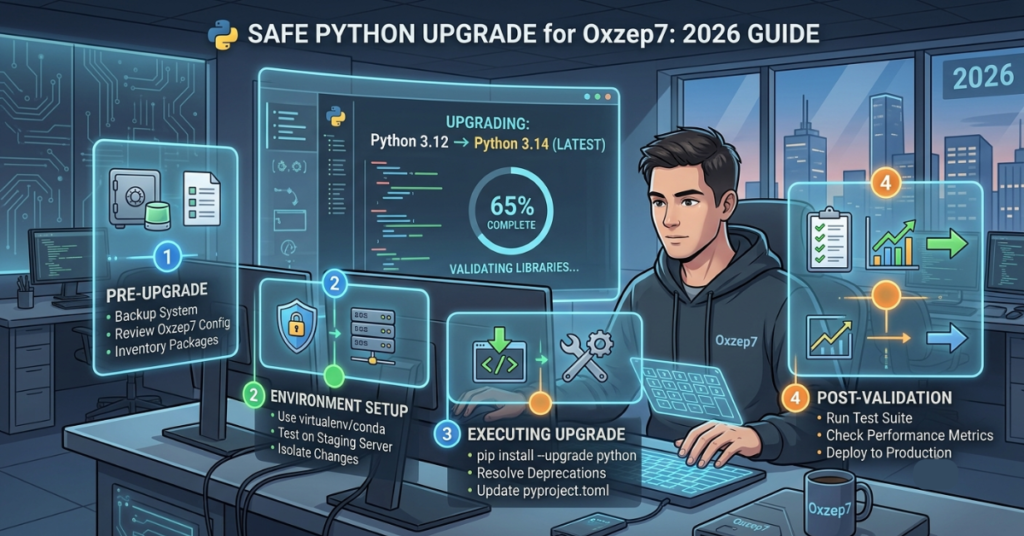
1) Inventory the current environment
Start by checking:
- the Python version
- installed packages
- pinned versions
- the operating system
- whether the app runs in a virtual environment
A virtual environment is especially important because Python’s venv module creates isolated package spaces, which keeps upgrades from leaking into the system-wide interpreter. That isolation is one of the best ways to reduce risk during a migration.
2) Back up everything before changing versions
Before any upgrade oxzep7 python step, save:
- configuration files
- dependency lists
- environment variables
- database snapshots if the app stores data
- a copy of the working environment
This is not overcautious. It is basic upgrade hygiene. Even Python’s install and environment docs make it clear that upgrades can replace existing installs or environments, so having a rollback path matters.
3) Use a fresh virtual environment
For most Python projects, the cleanest approach is to create a new environment instead of modifying a messy old one in place.
Typical flow:
- create a new
venv - activate it
- install the required packages again
- test the application
- only then retire the old environment
Python’s venv documentation describes virtual environments as lightweight, isolated package spaces with their own independent installs. That isolation is exactly what makes upgrades safer.
4) Upgrade packages explicitly
Python does not silently upgrade installed packages just because a newer version exists. The official docs say upgrades must be requested explicitly with commands such as python -m pip install --upgrade SomePackage.
That is useful for two reasons:
- you control what changes
- you can pin versions when needed
For example, if OXZEP7 depends on a specific release of a library, it is safer to update one dependency at a time than to refresh everything at once.
5) Test before deployment
Do not assume the upgrade worked just because the install finished successfully. Test:
- import behavior
- startup and shutdown
- core workflows
- API endpoints
- background jobs
- performance under realistic load
This is where many migration problems show up. A package may install cleanly but still break due to version mismatches, deprecated syntax, or subtle runtime changes. Python’s release notes and “What’s New” pages exist precisely because version-to-version differences matter.
Common Problems During an Upgrade
Dependency conflicts
One package may require a newer dependency while another still expects an older one. This is one of the biggest reasons upgrades fail in real projects.
Version drift
If one environment is updated but another is not, bugs become hard to reproduce. Virtual environments help reduce that problem.
Using an old Python baseline
The latest stable Python release is 3.14, released on 7 October 2025, and the Python release notes show continued updates into 2026. If your project is still on an older interpreter, you may be carrying old behavior and old limitations with it.
Skipping rollback planning
Many upgrade issues are not technical failures; they are operational failures. If you cannot restore the previous working state quickly, the upgrade is too risky for production.
Best Practices for a Smooth Migration
Use this checklist when you prepare to upgrade oxzep7 python:
- keep a requirements file or lock file
- upgrade one layer at a time
- test in staging first
- use separate environments for old and new builds
- document any breaking changes
- verify that
pip,venv, and the interpreter all match your target setup
Python’s documentation consistently favors explicit, controlled upgrades over implicit changes, and that is the safest mindset for any application built on Python.
Real-World Way to Think About It
If OXZEP7 is your app, treat the upgrade like a small release project, not a casual update. The best teams do not “just bump versions.” They compare the current environment, recreate it cleanly, validate behavior, and keep a rollback plan ready.
That approach saves time later because it reduces mystery bugs, support issues, and production surprises. It is also the most realistic way to handle an upgrade oxzep7 python workflow in an environment where the term itself is still emerging online.
Key Takeaways
- “Oxzep7” appears to be an emerging, Python-related software term rather than a well-established standard package name.
- The safest upgrade path is to isolate the environment, back up the current setup, and test every dependency explicitly.
- Virtual environments and explicit
pipupgrades are the core tools for reducing risk. - A good upgrade plan is reversible, documented, and validated before production use.
FAQ
What does “upgrade oxzep7 python” mean?
It most likely refers to updating a Python-based OXZEP7 environment, package, or application. Current search results suggest it is an emerging software term, so the exact meaning depends on the system you are working with.
How do I upgrade a Python package safely?
Use a virtual environment, then run an explicit package upgrade with python -m pip install --upgrade PackageName. Test the application before moving the change into production.
Should I upgrade Python itself or only the package?
That depends on what is actually causing the issue. If the problem is interpreter compatibility, upgrade Python; if it is a dependency issue, upgrade the package first and test carefully.
Why is a virtual environment so important?
Because it keeps project packages separate from the system Python installation. That makes upgrades easier to test, easier to reverse, and less likely to break unrelated projects.
What is the biggest mistake people make during upgrades?
The biggest mistake is changing multiple variables at once. If you upgrade the interpreter, dependencies, and configuration together, it becomes hard to tell what caused a problem.
Conclusion
The smartest way to handle upgrade oxzep7 python is to treat it like a controlled migration, not a quick patch. Identify what OXZEP7 refers to in your environment, isolate the work in a virtual environment, upgrade dependencies explicitly, and test before you ship.
That simple discipline is what turns a risky upgrade into a stable one. Apply the steps above, and you will be in a much better position to move forward with confidence.